

Adding Efficiencies to AIs, Square Roots in the Market, Invisibility Cloaks, and Cake Pans
Nemertes [Next] Newsletter Issue #36—December 19, 2025

Let me take the opportunity to wish you a warm and nurturing holiday season and happy new year, given that the Nemertes [Next] newsletter will be taking a break until January.
And, speaking of January, on the 21st we’ll be going on a virtual field trip to the Birthplace of the Internet in UCLA’s Boelter Hall with Len Kleinrock, who will show us the actual equipment used on October 29, 1969, for the initial communication between the first two nodes of the Internet’s precursor, ARPANET, and tell us stories about the day, the people (some of whom will also be in the Zoom room), and the early networking project as a whole.
To be part of this intimate tour, you have to be a member of the Nemertes community. You can join through by clicking through at the bottom of this post.
And, now for some news . . .
Nancy Kleinrock*
Content Director, Nemertes [Next]
LLMs have become multimodal, capable of working with not only text but also images, video, and audio (speech and music). Researchers at Concordia University have focused on speech, improving the processing of so-called audio tokens, which serve as the individual units of spoken language. Because speech carries information about meaning through, yes, words, but also accent, identity, emotion, and so forth, through tone of voice, pacing, and manner of speaking, the bitrate of audio tokens is high. To make speech more easily digestible by LLMs, the research team created a new audio tokenization methodology dubbed FocalCodec that retains both sound and meaning of speech at an ultralow bitrate, such that the FocalCodec output serves as an improved input modality for multimodal LLMs even as human listeners detect no difference between it and the corresponding original speech. (Haizhou Li and See Swee Lan, Singapore, Jul 2009)
Concordia researchers develop novel approach to help Large Language Models learn from speech
Speaking of AI doing more with less—or at least spreading out the computational load—MIT researchers have developed the DisCIPL (Distributional Constraints by Inference Programming with Language Models) framework to steer LLMs to efficiently delegate subtasks of a big ask to appropriately selected, specialized small language models before bringing results back together for synthesis. The goal is to take advantage of parallelisms by inducing models to collectively produce high-quality outcomes using reduced computational and energy resources. (Burton Smith, Santa Monica, Dec 2007)
Enabling small language models to solve complex reasoning tasks
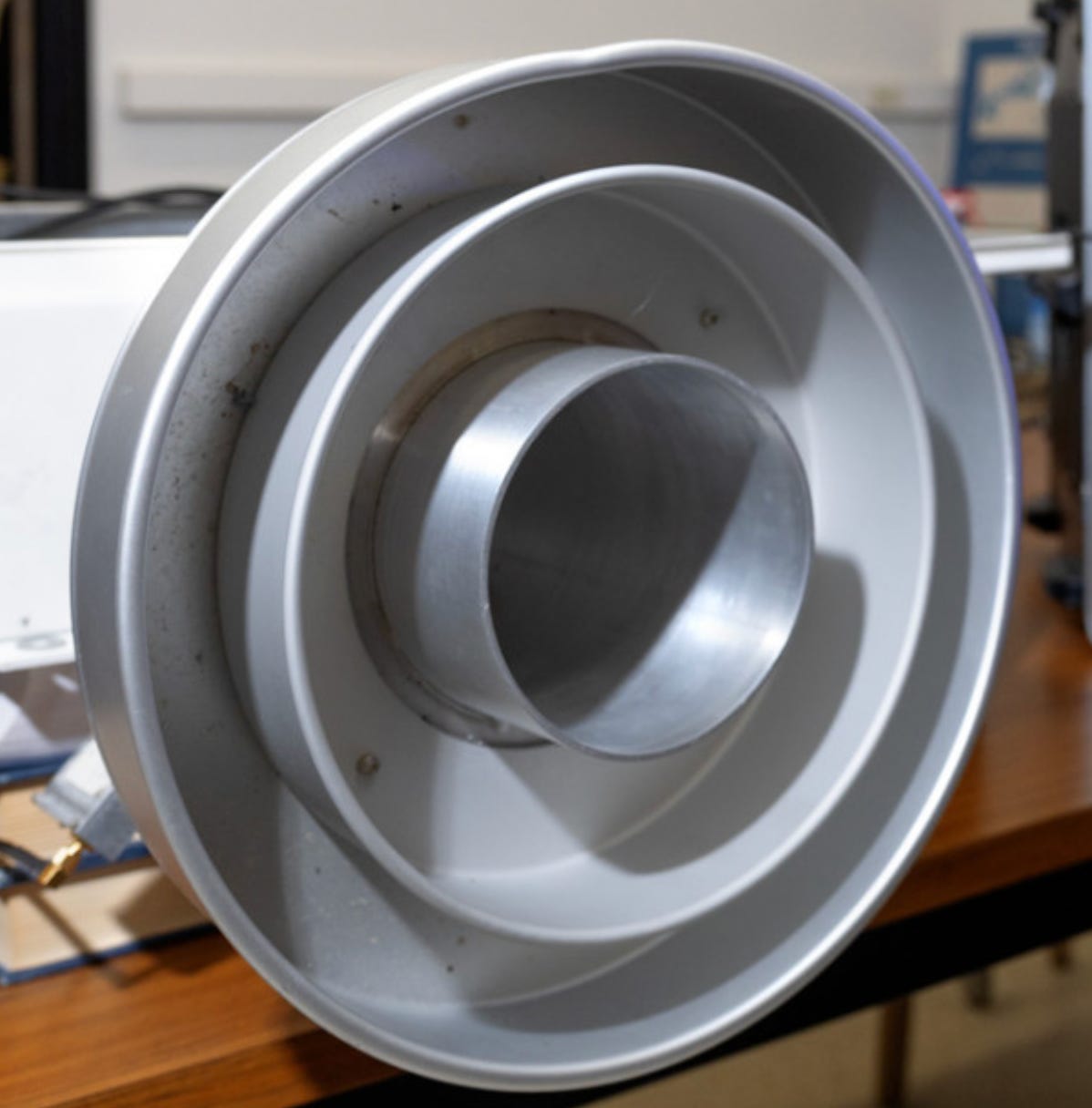
Telescopes are increasingly bespoke, designed to capture specific types of electromagnetic signals from afar (Nick Law, field trip, Chapel Hill, Mar 2024). This is particularly true for radio telescopes (Dennis Wingo, San Francisco, Dec 2014), and Cornell researchers are making a big splash with a small radio telescope design. The goal of the telescope—the Galactic Radio Explorer (GReX)—composed of eight stations distributed around the surface of the planet, is to capture data from fast radio bursts, a currently poorly understood astrophysical phenomenon. The constellation of receivers will be able to survey the entire sky (Marla Geha, Charlotte, Dec 2010); the form factor? A trio of concentric cake pans—really. This geometry minimizes sensitivity to human-made signals while focusing on radio waves arriving vertically through the atmosphere. Plus, the unit cost of the GReX is a mere pittance.
Cake-pan telescope searches sky for fast radio bursts
As you prepare for a new year of equities trading, you might wish to keep in mind the revalidation of the square root law. Kyoto University researchers analyzed all the Tokyo Stock Exchange transactions between 2012 and 2019—order submissions, trades, and cancellations—to establish a universal square root relationship between the change in a stock’s price and the number of shares traded. Previous studies have relied on size-constrained or proprietary datasets, but the scope of this work suggests that the square root law has broad applicability. In their work, the research team applies all manner of analogies from physics, making for a fun read.
The universal law behind market price swings
Korean researchers are using liquid metal composite ink to absorb, modulate, and shield electromagnetic rays. That is, an invisibility cloak. The ink’s liquid metal particles mesh with one another to create a flexible metamaterial that can be tuned to hide the cloaked object from, say, radar or communication waves, because of selective absorption. The tuning, in fact, is done through the act of physically deforming the easy-to-manufacture cloaking material. (Bogdan Popa, Miami, Dec 2011)
Harry Potter-style “moving invisibility cloak” technology developed
”I don’t know why people are so keen to put the details of their private life in public; they forget that invisibility is a superpower.”—Banksy
*This email is sent from, but doesn’t originate with, Substack; it’s written by me, Nancy Kleinrock. I invite you to write to me at nancy.kleinrock@nemertes.com with your thoughts—positive, negative, or otherwise—about this posting or whatever’s on your mind. If someone forwarded it to you and you like what you see, feel free to subscribe by clicking the button below.